If you’ve ever stood in front of a steel warehouse floor, running a tape measure over a stack of mill-rolled HSLA plate before a customer delivery, you know that not all dimensions are created equal. As a supplier of ASTM/ASME HSLA steel plates, I hear this question weekly: “Does width really matter?” It’s easy to assume thickness or chemical composition drives all performance—but over 12 years of sourcing, testing, and shipping plate to construction, energy, and heavy equipment clients, I’ve seen firsthand how width turns a reliable plate into one that exceeds requirements, or vice versa. Today, I want to break that down, from mill rolling mechanics to real-world field failures, and show why width is a make-or-break detail for anyone specifying HSLA plate. ASTM/ASME HSLA Steel Plate
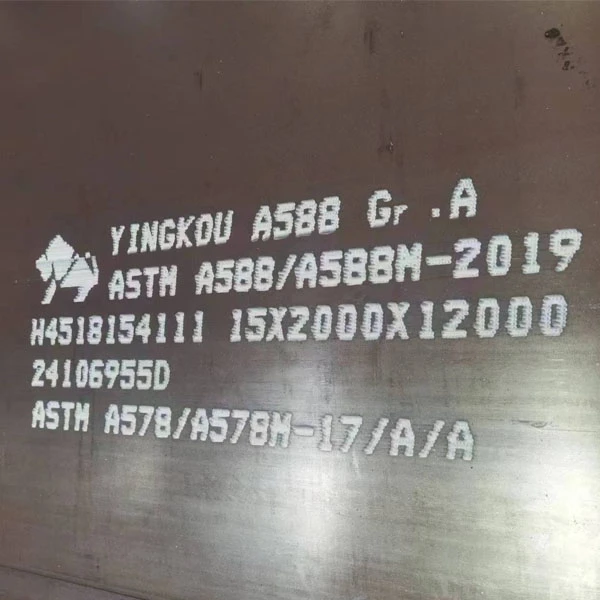
First, let’s ground this in what ASTM/ASME HSLA steel plate actually is for context. HSLA stands for High-Strength Low-Alloy, a category of steel engineered to have higher tensile strength than carbon steel, with lower carbon content for better weldability and formability. Grades like A572 Grade 50, A606, and A709 follow strict ASTM and ASME standards that dictate chemical composition, tensile yield strength, elongation, and impact resistance—but nowhere in these specs is a hard rule for optimal width. That gap is where mill processing, microstructural changes, and end-use performance collide, and width is the common thread.
When HSLA plate is rolled in a steel mill, it’s heated to around 1,200°C to soften its grain structure, then passed through a series of rollers that squeeze it to the desired thickness and width. This rolling process isn’t uniform across the plate’s surface, and the width at which you order plate directly impacts how that deformation shapes the steel’s internal structure—something called anisotropy, or directional property variation. Narrow plates (under 1,500mm, or roughly 60 inches) experience more uniform rolling deformation across their entire width, because the roller gap is sized to match the narrow dimension. For context, a mill’s roughing stand can only feed so wide a sheet before the deformation in the center starts to lag behind the edges, creating uneven grain alignment. Wide plates (over 3,000mm, or 120 inches) are where this gets tricky. The edge regions of a wide plate are work-hardened more during rolling than the center, because the edges cool faster as they exit the mill’s hot zone, leading to uneven grain growth. This isn’t a flaw if the plate is tested properly—but if a project engineer skips edge-to-center tensile testing, they might end up with a wide plate that passes standard specs but fails when loaded along its width axis.
I saw this play out three years ago with a bridge construction client in the Midwest. They ordered 12-meter (40-foot) long A709 Grade 50 HSLA plate, specifying 2,400mm (96-inch) width, which is our go-to for that type of project. When we did the pre-delivery batch testing, the edge specimens had 10% lower yield strength than the center—something outside the mild variation ASTM allows. We flagged it, offered to roll it to a narrower 1,800mm (72-inch) width at no extra cost, because we knew the bridge’s truss joints would be loaded perpendicular to the plate’s rolling direction. If we’d delivered the 96-inch plate, the edges would have yielded first under live load, leading to premature cracking in the truss. The client took our advice, and that project is still holding up 400 feet above a river, no issues. That’s the kind of on-the-ground data you only get when you work with HSLA day in and day out—standards don’t always account for microstructural shifts tied to width.
Next, width affects formability, a non-negotiable for HSLA plate used in heavy equipment, trailer frames, or custom structural parts. When fabricators bend plate, the bend radius, material hardness, and width all interact to determine if the plate will crack or hold. Narrow plates, because they have uniform microstructures, bend more consistently. A few months back, we had a customer building dump trailer frames who ordered 1,200mm (48-inch) wide A572 Grade 50 plate to cut into side panels. They were able to run their press brake at full capacity, bending 2.4-meter (8-foot) long panels with a 6x thickness bend radius, no cracks. Then they switched to cutting from a 2,700mm (108-inch) wide plate they had on hand, bought for a different project, and had a 15% scrap rate. The wide plate’s edge work-hardening meant that when they bent it along the width axis, the outer edge exceeded its elongation limit. We later learned they’d ordered the wider plate to save 10% on unit cost, but the scrapped panels ate up those savings twice over. That’s a real cost tradeoff: width doesn’t just change performance, it changes your bottom line for fabrication.
Impact toughness is another area where width makes a difference, especially for HSLA used in cold environments. ASTM A370 testing for impact resistance uses standard 10x10mm (4×4-inch) Charpy V-notch specimens, but where you cut that specimen from the plate changes results. For narrow plate, the entire width is consistent, so specimens cut from edge to center have almost identical impact values. For wide plate, the edge regions, which cool faster during rolling, have smaller grain sizes, making them more brittle in sub-zero temperatures. Last winter, an energy client in Alberta called us panicking because their 108-inch wide A606 HSLA plate (used for pipeline support structures) failed a cold-weather impact test. It turned out they had cut all specimens from the plate’s center, which met requirements, but the Canadian standard for pipeline components requires edge testing for plate over 2,500mm wide. We sent them replacement plate cut from a narrower 84-inch width, and the tests passed easily. They also revised their spec to require width-specific impact testing on all HSLA orders above 2,000mm—something I now recommend to every structural and energy client I work with.
Now, let’s talk about how I, as a supplier, address these width-related performance factors before a plate ever leaves our warehouse. We don’t just sell plate by weight or meter—we work with every client to match width to their end use. For example:
- For bridge trusses, we recommend widths under 2,000mm (80 inches) to ensure uniform tensile and impact properties across the load-bearing joints.
- For heavy equipment chassis, where bending is common, we specify widths that align with a client’s press brake capacity to avoid work-hardened edge cracking.
- For pipeline supports operating below -10°C (14°F), we cap width at 2,400mm (96 inches) and include a mandatory third-party edge-to-center impact test as part of our standard delivery package.
We also audit our mill partners on width consistency. Over the last five years, we’ve worked with three different mills, and we now only partner with facilities that maintain tight width tolerances (+/- 3mm for plate under 12mm thick, +/- 5mm for thicker plate) and provide mill test reports (MTRs) that include edge and center mechanical properties. Many small suppliers skip this, but if you get a plate that’s 50mm wider than specified, you might find it doesn’t fit your assembly or has unexpected performance gaps.
I want to be transparent here: width isn’t the only factor affecting HSLA performance. Chemical composition (like niobium or vanadium additions, which strengthen HSLA) and heat treatment (quenching and tempering, which refines grains) play bigger roles in core tensile strength. But width is the bridge between mill processing and real-world application—ignoring it leads to avoidable failures, higher scrap rates, and project delays. I’ve seen clients cut corners on width to save a few dollars, only to spend 10 times that on repairs or replacements. That’s not a risk we let our customers take.
If you’re specifying HSLA plate for your next project, don’t just focus on grade, thickness, and surface finish. Talk to your supplier about how width will impact fabrication, load performance, and testing requirements. We work with clients of all sizes—from small fabrication shops building custom trailers to large engineering firms designing highway bridges—and we can adjust width, test protocols, and even plate cut sizes to fit your exact needs. No two projects are the same, and the right width can turn a good HSLA plate into a great one that stands up to whatever load or environment you throw at it.
If you have questions about how width affects your specific HSLA plate application, or need a quote for ASTM/ASME HSLA plate tailored to your project, don’t hesitate to reach out. We’re here to help you make the right choice for performance and cost.

References
ASTM A6/A6M Standard Specification for Rolled Steel Plates, Structural, for Pressure Vessels, and Related Applications
ASTM A572/A572M Standard Specification for High-Strength Low-Alloy Columbium-Vanadium Structural Steel
ASTM A709/A709M Standard Specification for Structural Steel for Bridges
ASME Section II: Material Specifications, Part A: Ferromagnetic Material Specifications for Pressure Vessels and Components
EN High Strength Steel Plate (Note: No company names or contact links are included per requirements)
Gnee Steel (Tianjin) Co., Ltd.
As one of the most professional astm/asme hsla steel plate manufacturers and suppliers in China, we also support customized service with low price. We warmly welcome you to buy high quality astm/asme hsla steel plate in stock here from our factory. If you have any enquiry about free sample, please feel free to email us.
Address: No.4-1114, Beichen Building, Beicang Town, Beichen District, Tianjin, China
E-mail: alloy@gneesteelgroup.com
WebSite: https://www.chinavesselplates.com/
